Shannon is back to introduce us to the Cailleach,( pronounced KAL-yakh) a fascinating and powerful Celtic goddess. Now, to Shannon…
Last weekend we celebrated Samhain, the time of year when the veil is thin and our ancestors are near. If you missed the Samhain blog, head to the previous blog post to read about it.
After Samhain, we move into the time of the Cailleach, or the Crone. The Cailleach is an ancient goddess whose stories are found throughout the Celtic world. Her name is most commonly understood to mean hag or crone, although veiled one is another common interpretation. She is associated with several things, including the ancestors, winter, time, and the wisdom that comes with living a long life.
Many of the stories surrounding the Cailleach describe how she shaped the landscape by dropping boulders from her apron. She is often portrayed as a giant in these stories. She is deeply associated with the land and is said to have helped shape mountains, caves, rivers, streams, and wells. Some stories also associate her with storms, bringing lightning and thunder across the land. Interestingly, the Cailleach is not only associated with the harshness of winter but also with the creation of the very landscape that sustains life. She is often linked to death and dying, which symbolically connects with winter, when the green things lie dormant and frozen, preparing for new life in the spring.
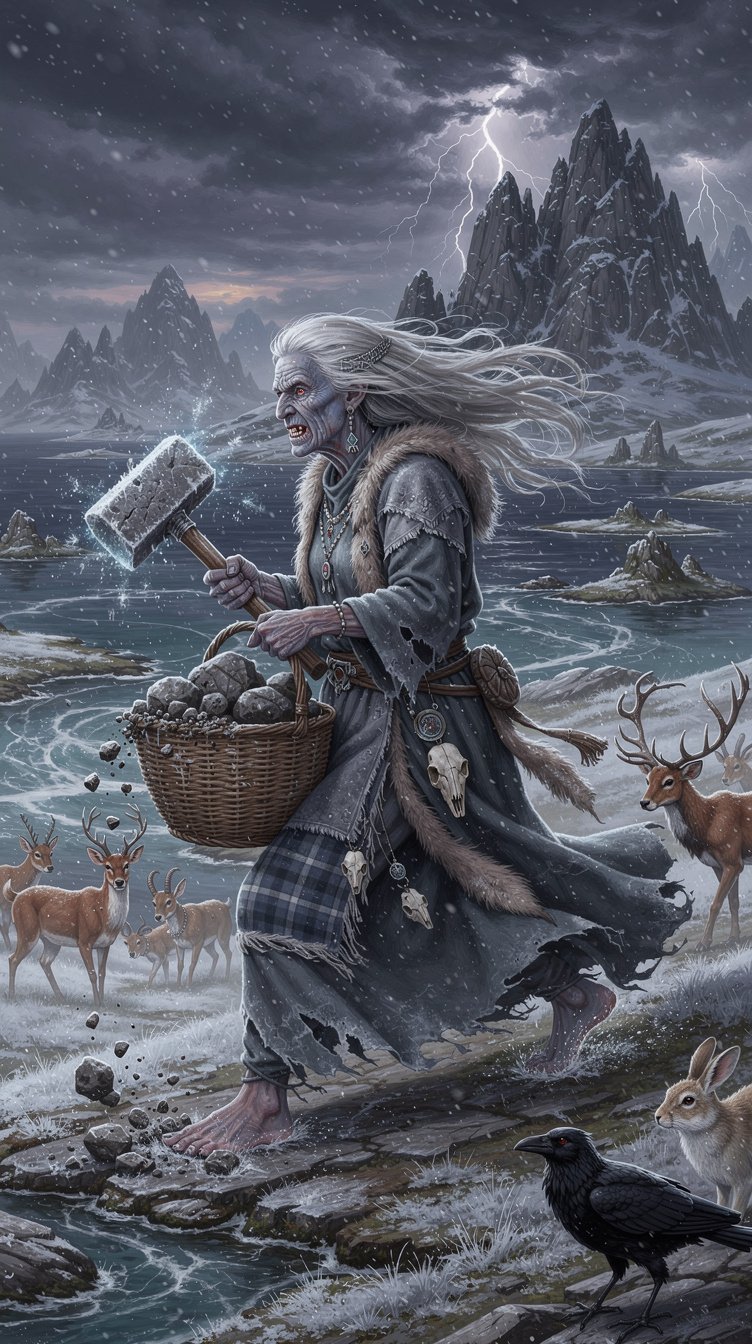
A depiction of the Cailleach as she walks across the land
The beginning of November marks the traditional transition into the Cailleach's season. In some Celtic traditions, November 1 was associated with the beginning of her reign each year. After Samhain, the Cailleach is said to walk across the land, bringing ice, snow, and wintry weather. This seasonal transition marks the descent into the darker half of the year as we approach the winter solstice.
The Cailleach's reign is traditionally said to last from Samhain (November 1) to sometime in the spring. Some traditions or stories say that the Cailleach’s time lasts all the way until Beltane (May 1). Others say that her most powerful time of the year is Samhain to Imbolc (February 1). Her appearance coincides with the beginning of winter, and she eventually retreats as spring begins to emerge. In some stories she is connected to the goddess Brighid, and Brighid’s emergence at Imbolc coincides with the Cailleach’s retreat back out of sight.
There is an old tradition in Ireland associated with Lá Fhéile Bríde, celebrated on February 1st. This is the day when the Cailleach is said to gather firewood to prepare for the remainder of winter. If the weather on February 1 is sunny and bright, winter will last longer because the Cailleach has been able to gather plenty of firewood. If the day is cold and wet, however, she is said to be asleep and running out of firewood. Since she hasn't gathered more, winter will soon come to an end. This reminds me of the tradition in the US of Groundhog day, when we wait to see if the groundhog sees its shadow when emerging from its burrow on February 2nd. If it sees its shadow, we’ll have 6 more weeks of winter; if it doesn’t spring is coming early.
As we move into late autumn and the winter season, the Cailleach reminds us that even the darkest and coldest parts of the natural cycle have their place. Beneath the frozen landscape, life is simply waiting for its time to return. May the story of the Cailleach remind you that we are part of nature, and that we too need time to slow down, go inwards, and take stock of everything hidden in our inner world. What we find in our inner depths is an integral part of shaping the landscape of our life as we begin growing again in the spring.
I referenced “Pagan Portals – The Cailleach, by Rachel Patterson” while writing this blog If you want to dive deeper into the Cailleach, this text is a great resource!
Thank you, Shannon, for this in depth look at the Cailleach as we approach her season of winter.
May you be filled with inner light,
Kelley
