Meet the Morrigan
The “Nightmare Queen”, “Great Queen”, or “Queen of Phantoms”.
Lately, I’ve been introducing you to the Irish Gods and Goddesses that have inspired the Of Gods and Monsters series. Today, we’ll take a look at another Goddess whose magic and might as a war goddess has been a source of inspiration for the books.
You’ve met my daughter Shannon before when she’s delved into the astrological charts of Mary, Aisling, and Geraldine, three of the characters from the Of Gods and Monsters series. Today, Shannon has written another guest post about the Morrigan, another Tuatha Dé Danann goddess.
Meet: The Morrigan.
Morrigan comes from Old Irish, and likely means “Nightmare Queen”, “Great Queen”, or “Queen of Phantoms”. Whatever her name means exactly, we do know that The Morrigan is a warrior goddess, one who goes by many names, including Morrigu, Badb, Macha, Anu, Danu, and Nemain, to name the most common. In fact, “The Morrigan” is commonly considered a title used for three sister goddesses all grouped together under this name. The Morrigan is a goddess of the Tuatha Dé Danann, and she is referenced often in Irish mythological texts.
Beyond her association as a warrior goddess, the Morrigan is associated with death, battle, prophecy, fate, and magic. For example, the Morrigan is said to have the ability to predict the deaths of warriors in battle, indicating that she has oracular gifts. She is a shapeshifter, often shifting into the shape of a crow in her stories. In mythology, when the Morrigan flies overhead during battle, her caws are omens for victory for her allies or death for her foes. The warriors see her and either retreat or dig their heels in to fight for their lives. You see some of the characters in the Of Gods and Monsters series shapeshift into crows, like the Morrigan. Ita, Bevin, and Devla are warriors that join Aisling, Tommy, and their friends in the fight against the Fomorians, and they have the ability to shapeshift into crows, just like the Morrigan, who is crafted as their ancestor in the stories.
Another way the Morrigan shows up in Irish mythology is as an omen of death even off the battlefield. The Morrigan would appear to kings or revered warriors, warning them of their impending doom. She also shows up in mythology as the “washer at the ford”. In mythology, the washer is generally identified as Badb or a member of the Tuatha Dé Danann—remember that Badb is one of the most commonly used names for the Morrigan, and she is a member of the Tuatha Dé Danann. The washer at the ford is a woman found washing clothes or armor at the ford of a river who offers a prophecy of doom to the character who stumbles upon her. It is said that when someone stumbled upon her, she would be washing their bloody clothes or armor, signifying that person’s impending death. An example of when we see the Morrigan in the role of washer at the ford is in the story of the Second Battle of Mag Tuired (a battle against the Fomorians, mentioned in a previous newsletter/blog post), when she meets with the Dagda, her husband and the “father god” of the Tuatha Dé Danann before the battle starts. The Dagda meets her as she is in the role of washer at the ford, and she delivers a prophecy of the death of his enemies. This prophecy comes true, as the Tuatha Dé defeat the Fomorians at the end of the battle. There are many examples of the Morrigan showing up, as a woman washing at the ford, or as a crow, to deliver messages before battle. The Morrigan in mythology is not necessarily a goddess who fights on the battlefield with sword or spear; rather, she is a goddess who is present before or during battle, sharing messages or prophecy and spurring her warriors on.
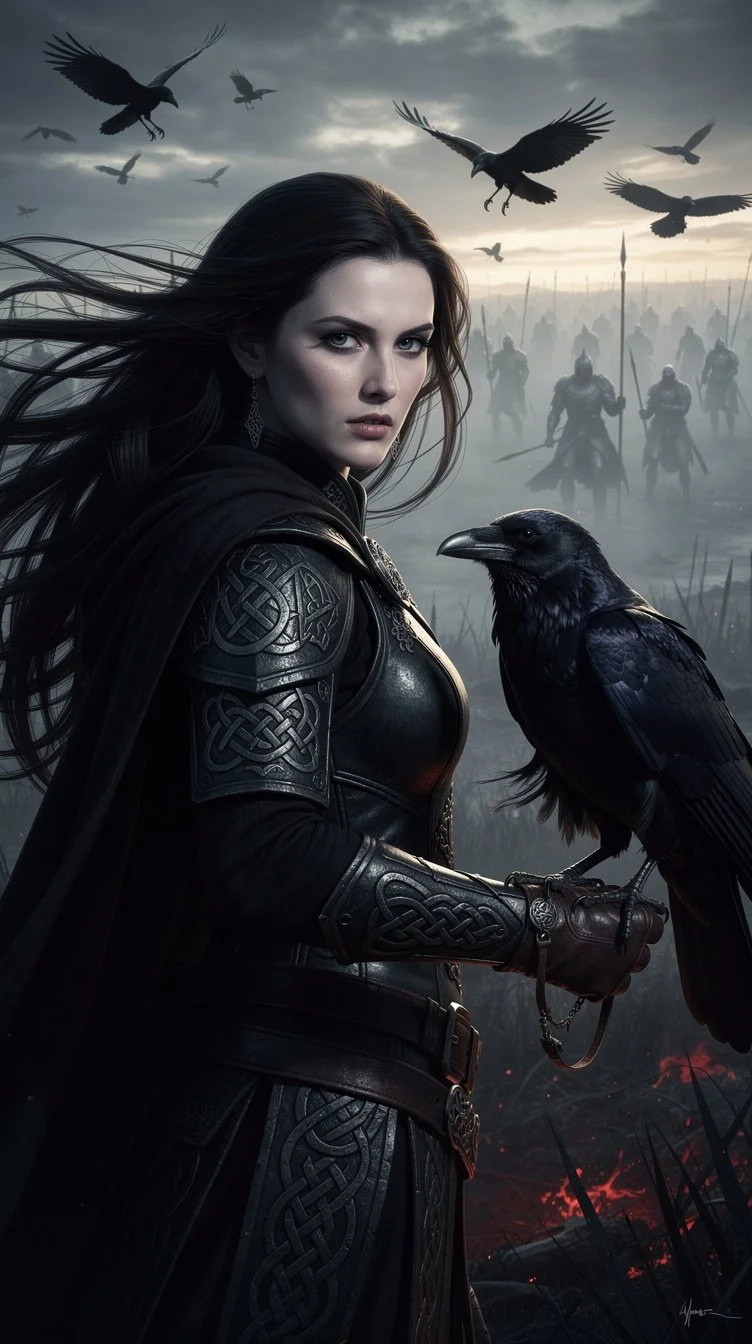
A depiction of The Morrigan
There is so much that could be said about the Morrigan. If you’re interested in learning more about this Irish Goddess, I recommend the books, “The Morrigan: Celtic Goddess of Magick and Might” by Courtney Weber, and “Pagan Portals: The Morrigan” by Morgan Daimler.
Until next time,
Kelley & Shannon
