The Fomorians: Ireland's Ancient Dark Force
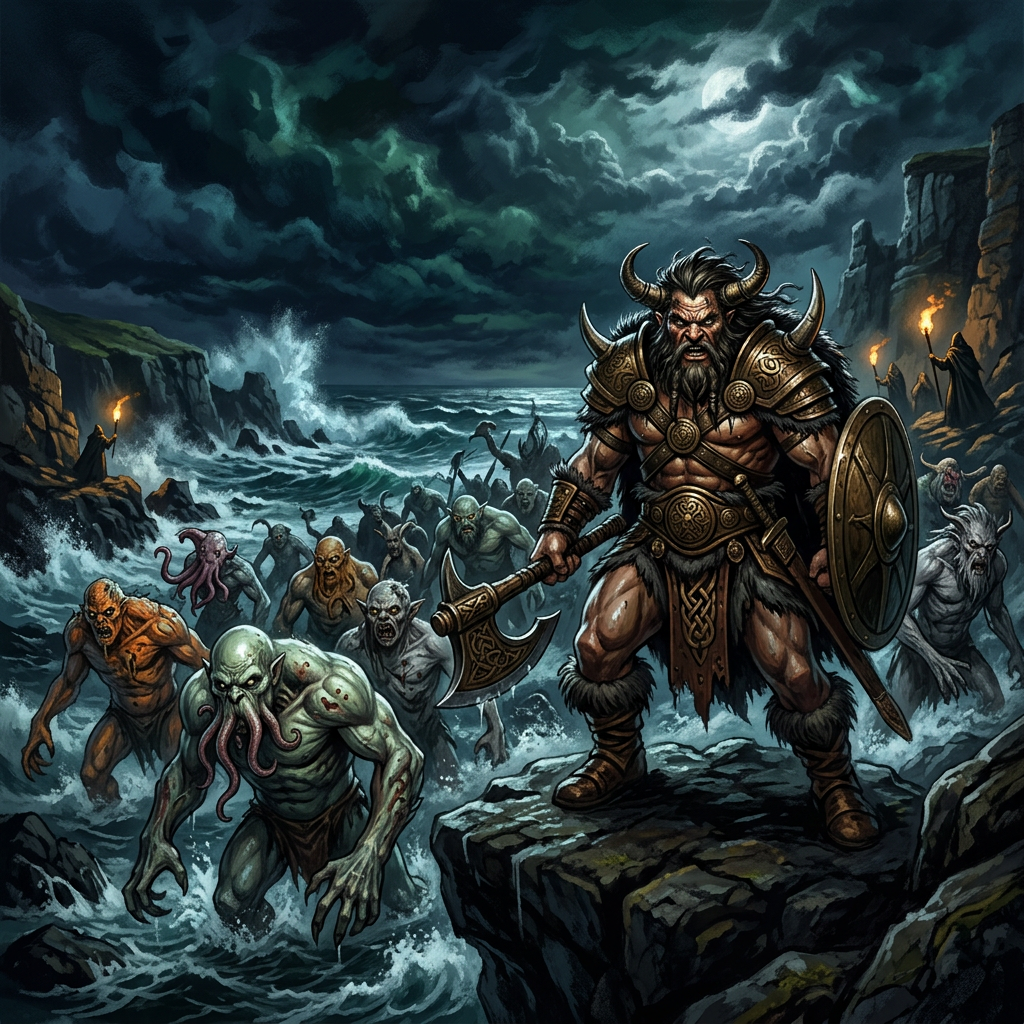
Ancient. Monstrous. Powerful. Meet the Fomorians, Ireland's darkest myth, explained.
Long before the gods arrived in Ireland, something darker was already there — ancient, powerful, and hungry for dominance. They were the Fomorians, and their shadow stretches across Irish mythology.
Who Were the Fomorians?
The Fomorians were one of the oldest races in Irish mythology, a supernatural people described by scholar T.W. Rolleston in his book Celtic Myths and Legends as "huge, misshapen, violent and cruel people, representing, we may believe, the powers of evil." They possessed immense strength and terrifying supernatural abilities, and were often portrayed as half-human and half-monster. Yet not all Fomorians were monstrous in appearance — some were strikingly beautiful, which in many ways made them all the more dangerous.
At their core, the Fomorians represent primordial chaos — a dark, untamable force in opposition to the divine order that would eventually come to rule Ireland. Understanding them means understanding the very nature of conflict in Irish myth: the eternal struggle between darkness and light, destruction and creation.
A Name Born from the Deep
The name Fomorian speaks to their origins. The Irish word fo means under and muir means "sea”. According to the reference book, Celtic Mythology, from Geddes & Grosset, their name has been translated “…both as sea giants and as under-demons, and they are thought to have had their home under the sea.” Either way, the sea has always been their domain.
The Wars for Ireland
Over centuries, wave after wave of peoples came to Ireland — the Partholans, then the Nemedians, and later the Fir Bholg — and the Fomorians were the shadowy, ever-present threat against all of them. They were demonic adversaries who fought each arriving race for dominance of the island they considered their own. Then came the Tuatha Dé Danann
The Tuatha Dé Danann
The Tuatha Dé Danann were a divine race, skilled in magic, wisdom, and the arts of war, who swept into Ireland on flying ships hidden within a dense magical cloud. They defeated the Fir Bholg at the First Battle of Magh Tuiredh (Moytura) and seized control of Ireland. In that battle, their king, Nuada, lost his arm, and under their laws, a king who was not whole in body could not rule. Ireland needed a new king.
Beautiful Monsters: The Story of Bres
Not all Fomorians were monsters in appearance. The most notable exception was Bres—golden-haired, striking, and considered one of the most beautiful figures in all of Irish myth. He was the son of Elatha, a Fomorian prince, and Ériu, of the Tuatha Dé Danann, making him a creature of two worlds.
When Nuada was forced from the throne, Bres was chosen to rule in his place. It was a catastrophic mistake.
Bres was beautiful on the outside, but every bit the Fomorian within. He was cruel, avaricious, and deeply inhospitable — a terrible failing in any king of the age. He levied punishing taxes on the Tuatha Dé Danann and ruled with cold indifference to their suffering. His downfall came, as it so often did in the old tales, through the power of words. When Bres refused to welcome a bard to his court, which was a profound insult in Celtic culture, the bard responded with a devastating satirical poem that shamed the king before all of Ireland. Humiliated and stripped of his authority, Bres was forced from the throne.
Beautiful on the outside, but rotten to the core. As was the case with many of the Fomorians.
The Second Battle of Moytura
Furious at Bres's removal and hungry to reclaim dominance over Ireland, the Fomorians rose again. What followed was the Second Battle of Magh Tuiredh. It was a magic-filled conflict between divine champions, showcasing the ancient power of each side. In the end, the Tuatha Dé Danann prevailed. The Fomorians were driven from Ireland, cast back into the darkness from which they had come.
Balor of the Evil Eye
No figure among the Fomorians is more fearsome than Balor of the Evil Eye, the king of the Fomorians, and one of the most powerful beings in all of Irish mythology.
Balor possessed a devastating weapon: his Evil Eye. Its gaze killed instantly, and its heavy lid required four men to pry open. On the battlefield, it was annihilating.
But Balor carried a prophecy with him like a wound. It was foretold that he would be killed by his own grandson. In a desperate attempt to cheat fate, he locked his only daughter, Ethlinn, away in a tower on Tory Island, far from any man. Fate, as it always does in the old myths, found a way. Ethlinn gave birth to a son, Lugh, who would become one of the greatest heroes in Irish mythology, the god of light and skill. And it was Lugh who, at the Second Battle of Moytura, killed Balor with a single sling-stone driven straight through the Evil Eye, fulfilling the prophecy and ending the Fomorian king's reign of terror.
After the Battle: Tory Island and the Sea
After their defeat, the Fomorians retreated back to the depths of the sea and to their Irish stronghold, Tory Island, a remote and windswept isle off the coast of County Donegal in the far north of Ireland. Tory Island is no legend. It exists to this day, inhabited and ancient, its landscape still carrying the weight of those old stories. But that is a tale for another blog post.
The Fomorians in the Of Gods and Monsters Series
So how do the Fomorians come alive in my Of Gods and Monsters series?
In the books, the Fomorians are portrayed as they have always been — monstrous, powerful, and driven by an ancient hunger to reclaim what was once theirs. They dwell in the Underworld, a realm I explore more fully in book 3, The Fomorians, when Aisling is taken there by force. Some Fomorians have escaped the Underworld and crept back to their old haunt of Tory Island, biding their time in the shadows of that windswept rock.
One creative liberty I've taken is giving certain Fomorians the ability to shapeshift into human form — a power not found in the original mythology, but one that felt true to their cunning and their ambition. If the Fomorians intend to retake Ireland, they must first move unseen among its people. This ability allows them to blend into Irish culture, hiding in plain sight until it is far too late to stop them.
I also gave the Fomorians a hierarchy of appearance tied to status. Lower-ranking Fomorians bear the full weight of their monstrous nature in their skin tones of mostly pale green and orange. They are monstrous, terrifying — large and bulky, powerful and destructive. But those of royal blood are something else, and when they are shifted into their true form, they are darker, more powerful, and more striking. The king of my Fomorians, a descendant of the great Balor himself, has a bronze skin tone when he is shifted into the form of a mighty, fearsome warrior. His queen and family share this ability. They are beautiful and terrible in equal measure, just as the old myths always warned.
Book Excerpt
Below is an excerpt from book 1, The Dreammasters, when Aisling first encountered a Fomorian, though she didn’t know at the time that the monster she saw was a Fomorian.
“My head smacked the window with a thunk when the bus scaled a speed hump and dropped to the other side. I glared up at the drier, a young man with acne, oily hair, and an expression that warned against engaging him in conversation…He caught my eye in the massive rearview mirror above his head, his features suddenly distorted and grotesque in the reflection. I sucked in my breath…The bus driver watched me, his eyes…now bulbous orbs of indeterminate color, wide and pulsing with malevolence…His body had filled out, and muscles bulged under his thin jacket. He raised a hand and flexed long, thick fingers sporting talons rather than nails.”
If you enjoyed this deep dive into Irish mythology, I'd love to hear from you! Which Fomorian fascinates you most — the beautiful and cruel Bres, or the fearsome King Balor and his deadly eye? Tell me in the comments below.
Happy reading, and may your mythology be dark and wonderful,
Kelley
